
KEY TAKEAWAYS
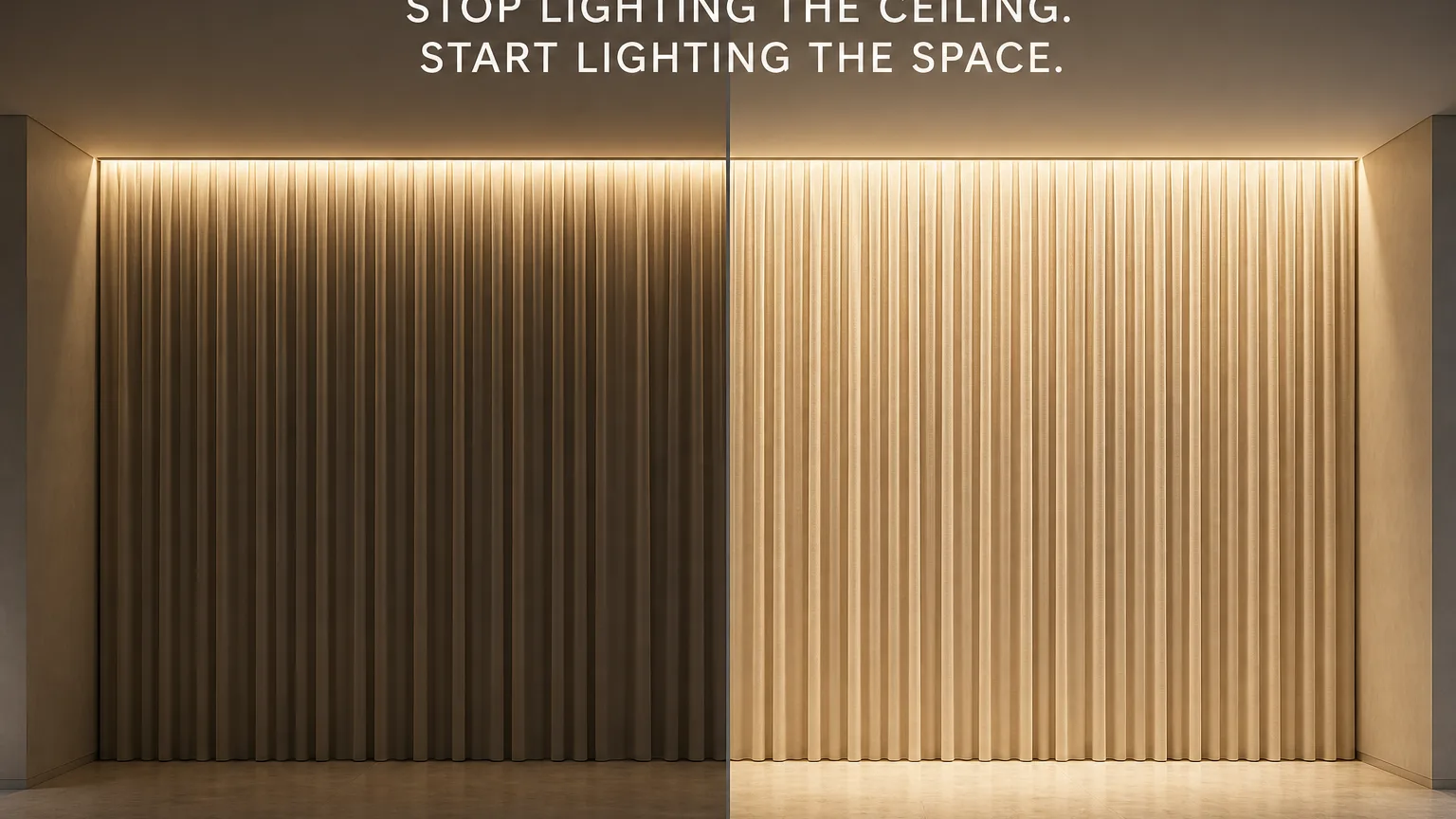
- A bright ceiling does not guarantee a well-lit vertical surface.
- Optical distribution is often more important than simply increasing wattage.
- Use 45° optics for controlled close-range wall, curtain, shelf and premium display lighting.
- Use 80° optics for wider general, background, museum showcase and long-format artwork illumination.
- Confirm the final choice with IES/LDT data and project conditions.
- Use the Lumi Adjustable range of up to 180° when construction tolerances change the beam landing.
01The Client Problem: Light at the Top, Darkness Below
A curtain cove can look bright while the curtain itself remains poorly illuminated. Conventional LED strips emit diffuse light in many directions, so a large share of the output stays inside the cove or near the ceiling. The upper folds become bright, but illuminance falls quickly across the middle and lower surface.
For designers and project teams, the real question is not whether the strip is bright. It is whether useful light reaches the complete vertical plane. Increasing wattage alone may make the top brighter without solving the distribution problem.
02The Difference Is Distribution, Not Simply Brightness
Useful vertical illumination depends on where the light goes. Lumi uses individual precision optics to control the beam and direct light farther away from the ceiling. This allows a compact linear source to illuminate curtains, walls, merchandise and artwork with a more purposeful distribution.
The goal is not an unrealistically flat surface. Natural modelling and some falloff are expected. The improvement is that the middle and lower parts remain visibly illuminated instead of disappearing into darkness.
Choose the Optical Solution by Application
45° Controlled Reach
For curtains, close-range wall lighting, shelves and premium cabinets displaying watches, handbags or jewellery.
80° Wider Coverage
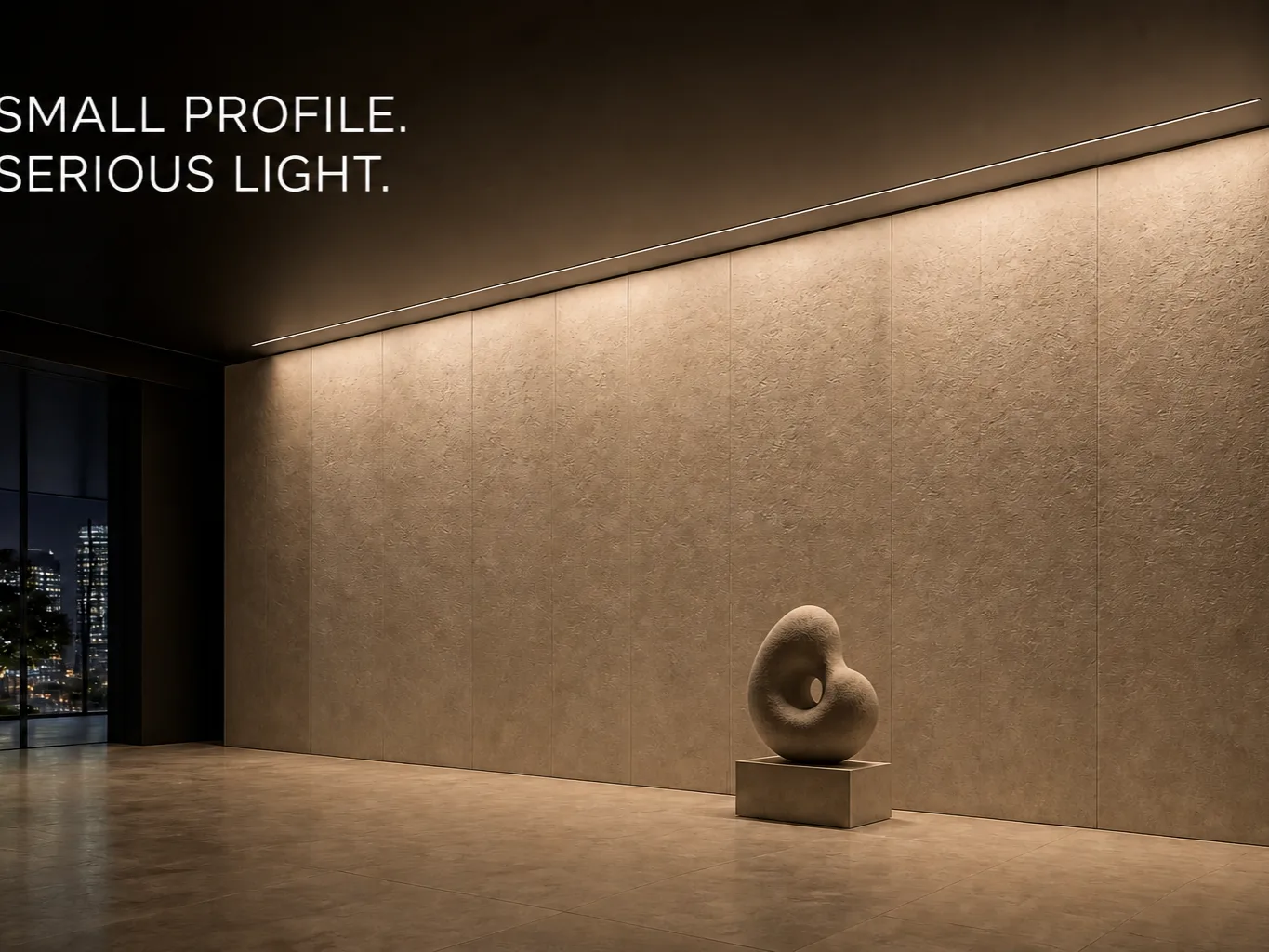
For general illumination, background lighting, museum showcases and long-format artwork.
7×9 mm Compact Profile
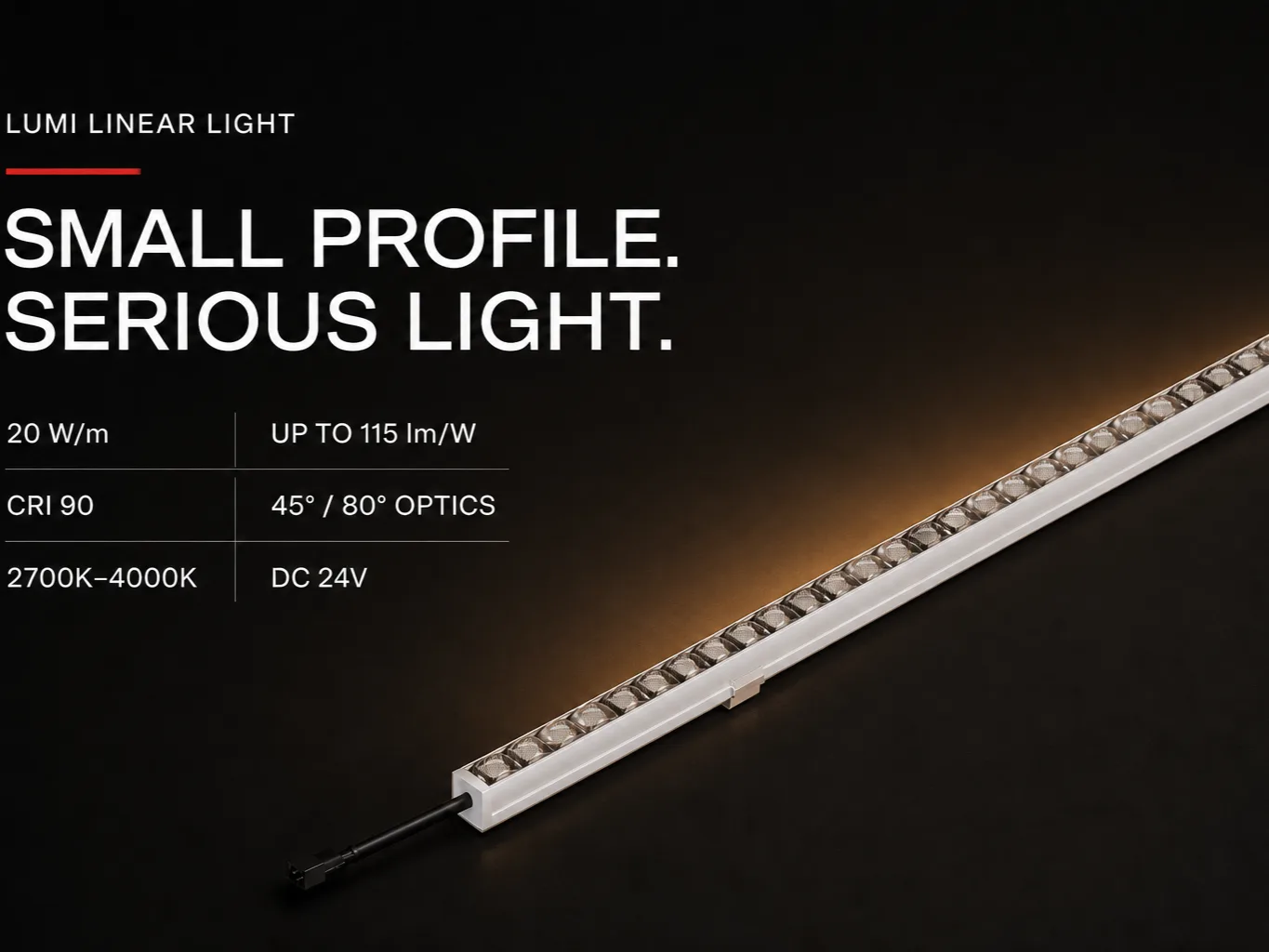
Precision optics in a minimal form, with luminaire efficacy reaching up to 115 lm/W depending on the version.
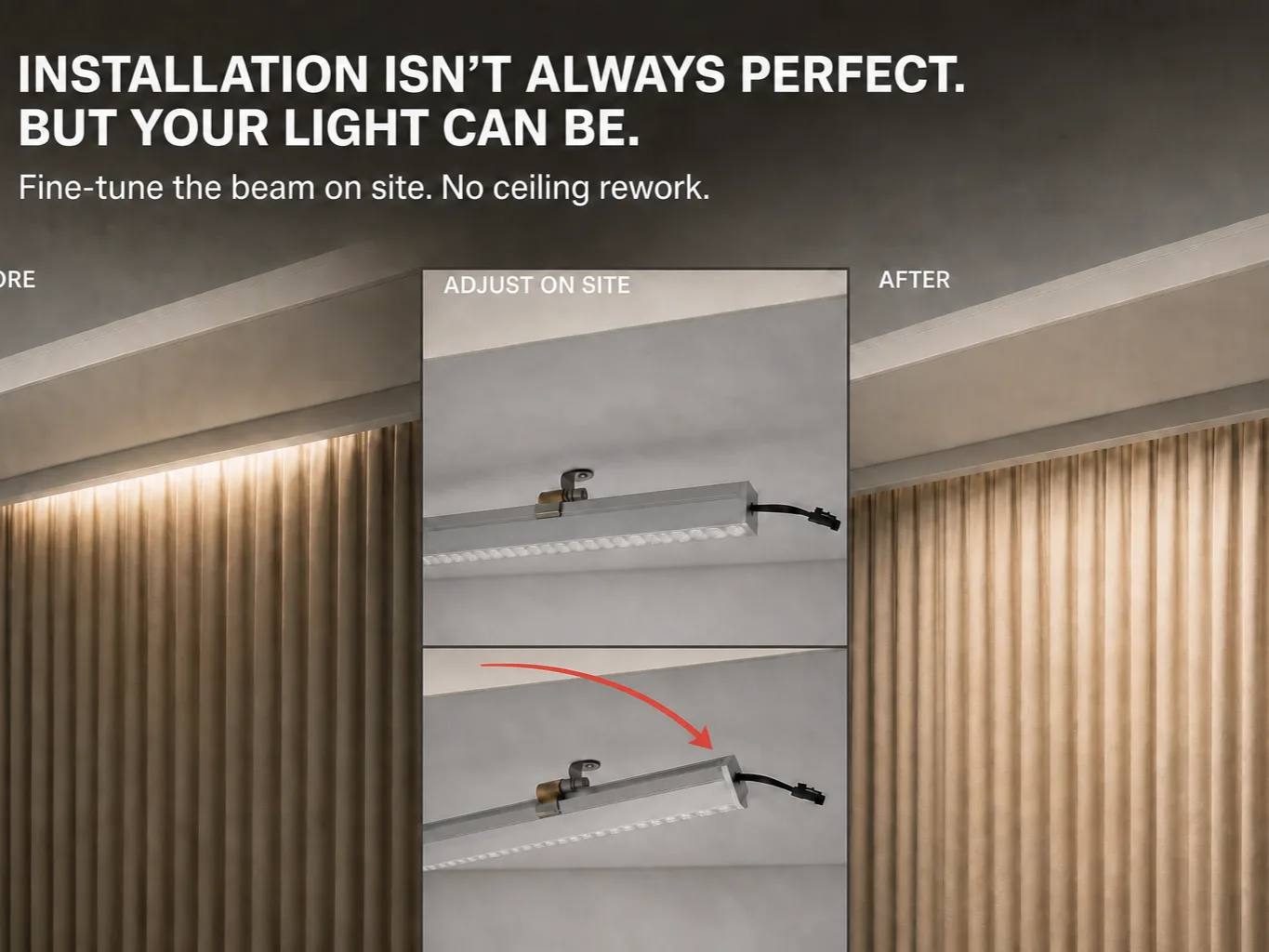
180° Adjust on Site
Fine-tune the internal optical module through a range of up to 180° when the installed distance does not exactly match the drawing.
03How to Choose 45° and 80° Optics
Choose the optic according to the target surface, installation distance and required coverage. A 45° distribution provides controlled reach and intensity for close-range wall or curtain lighting, shelf lighting, and premium display cabinets containing watches, handbags, jewellery or accessories.
An 80° distribution provides wider coverage for general illumination, background lighting, museum showcases and long-format artwork. It is useful when the luminaire is close to the target and the design priority is broader, more continuous coverage. Final selection should be checked with photometric files or a project lighting calculation.
Application Selection Guide
| Application | Recommended Starting Point | Customer Benefit |
|---|---|---|
| Curtain, wall, shelf or premium cabinet | 45° controlled distribution | Useful reach with focused vertical and display illumination |
| General, background, museum showcase or long artwork | 80° wider distribution | Broader, more continuous close-range coverage |
| Installation distance varies on site | Lumi Adjustable | Correct the beam without relocating the housing |
04Small Profile, Measurable Performance
Lumi places precision optics inside compact profiles. Current specification examples include 7 × 9 mm, 10 × 10 mm and 13 × 18 mm sections, all rated at 20 W/m. Depending on the version, luminaire efficacy reaches up to 115 lm/W, with CRI 90 and 2700K–4000K options.
These values matter because a minimal architectural detail should not require a minimal lighting effect. The purpose of the optical system is to convert output into useful light on the intended surface.
05When the Installation Distance Is Not Perfect
Drawings can be precise, but real construction includes tolerances. A small difference between the luminaire and the wall, curtain or display can move the beam away from its intended position. With an adjustment range of up to 180°, the Lumi Adjustable internal optical module can be fine-tuned on site while the housing remains installed.
This gives contractors and designers a practical way to correct the beam without relocating the fixture or rebuilding the ceiling. For project evaluation, request the relevant IES/LDT file, installation drawing and lighting simulation before final selection.