
KEY TAKEAWAYS
- Glare may be direct, reflected, discomforting or visually disabling.
- Anti-glare design controls luminance in real sightlines.
- Deep optics help, but layout and background brightness remain decisive.
- Small apertures can still be intense.
- Calculation and mock-ups should verify sensitive applications.
01Comfort Is Lost When the Source Wins
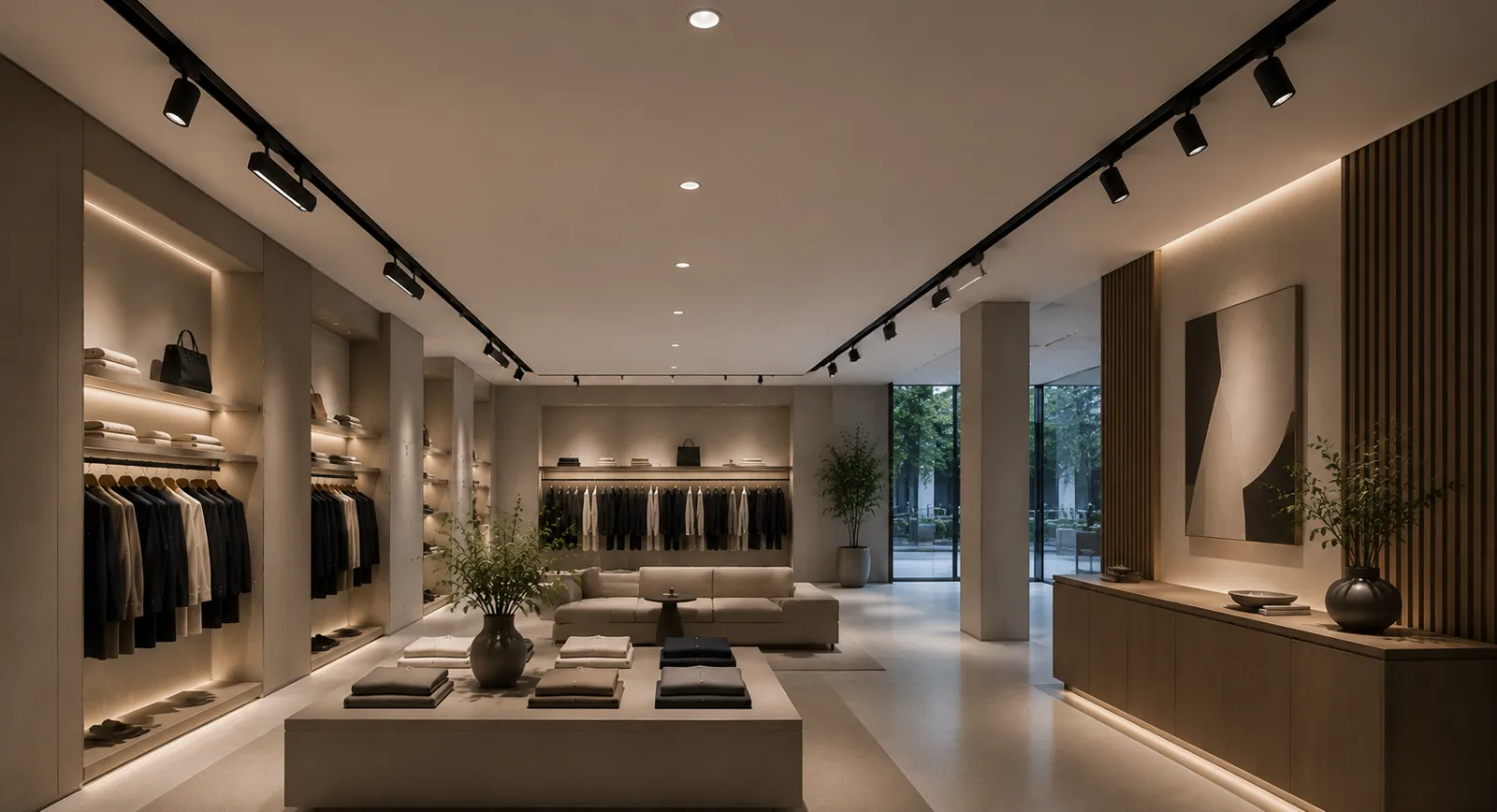
Walk toward a reception desk and the intended focal point may disappear behind a row of brilliant ceiling apertures. Nothing is necessarily wrong with the illuminance level; the problem is that the sources have become the brightest and most insistent elements in the field of view. Anti-glare lighting is the coordinated control of those luminance relationships. It aims to limit direct view of intense light-emitting surfaces, reduce disturbing reflections and maintain enough background brightness for comfortable adaptation. The term does not describe one optic or one numerical threshold. A deep baffle can help, but it cannot correct a luminaire placed directly in a long sightline or aimed into polished glass.
What Is Anti-Glare Lighting — Design Essentials
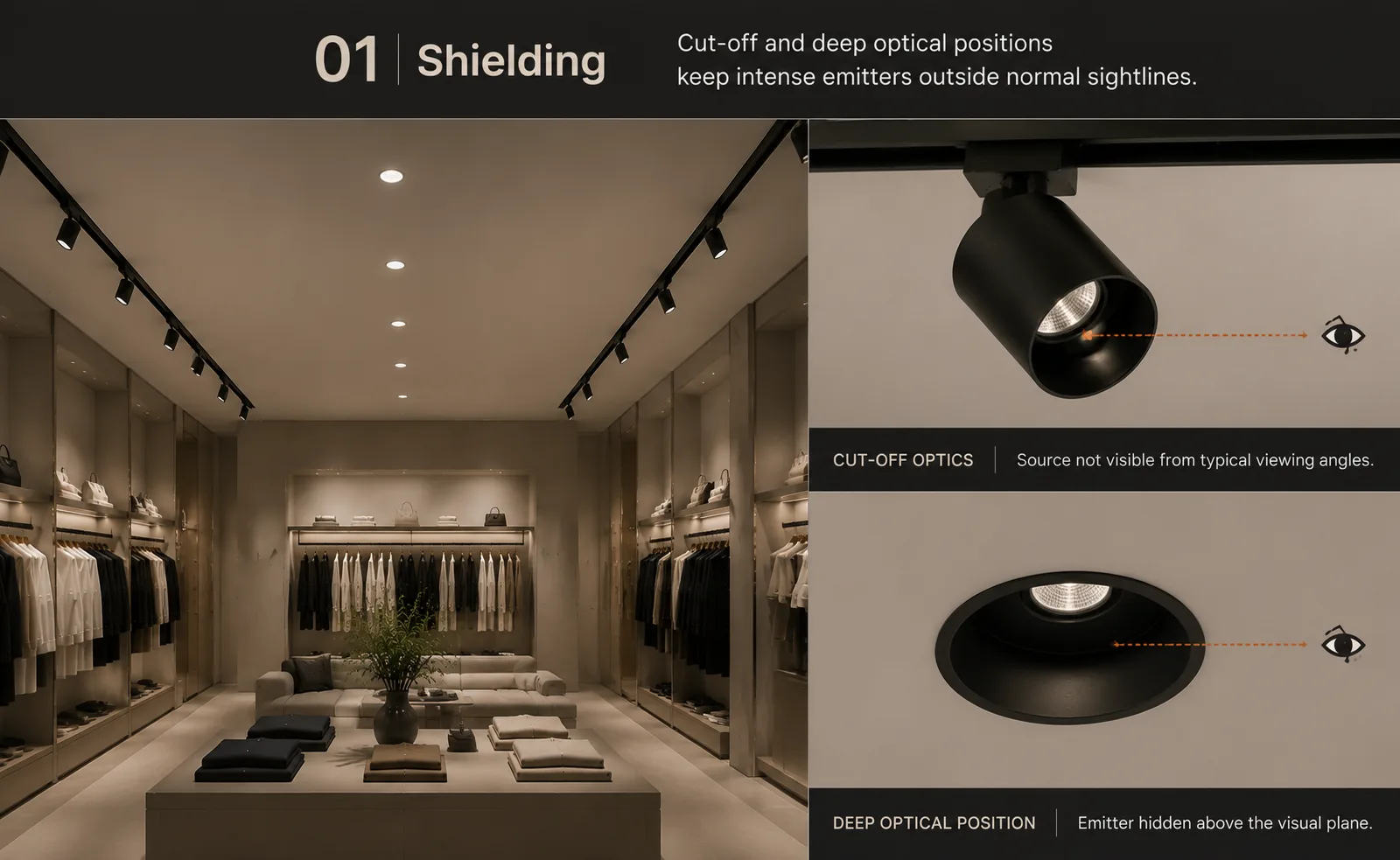
01 Shielding
Cut-off and deep optical positions keep intense emitters outside normal sightlines.
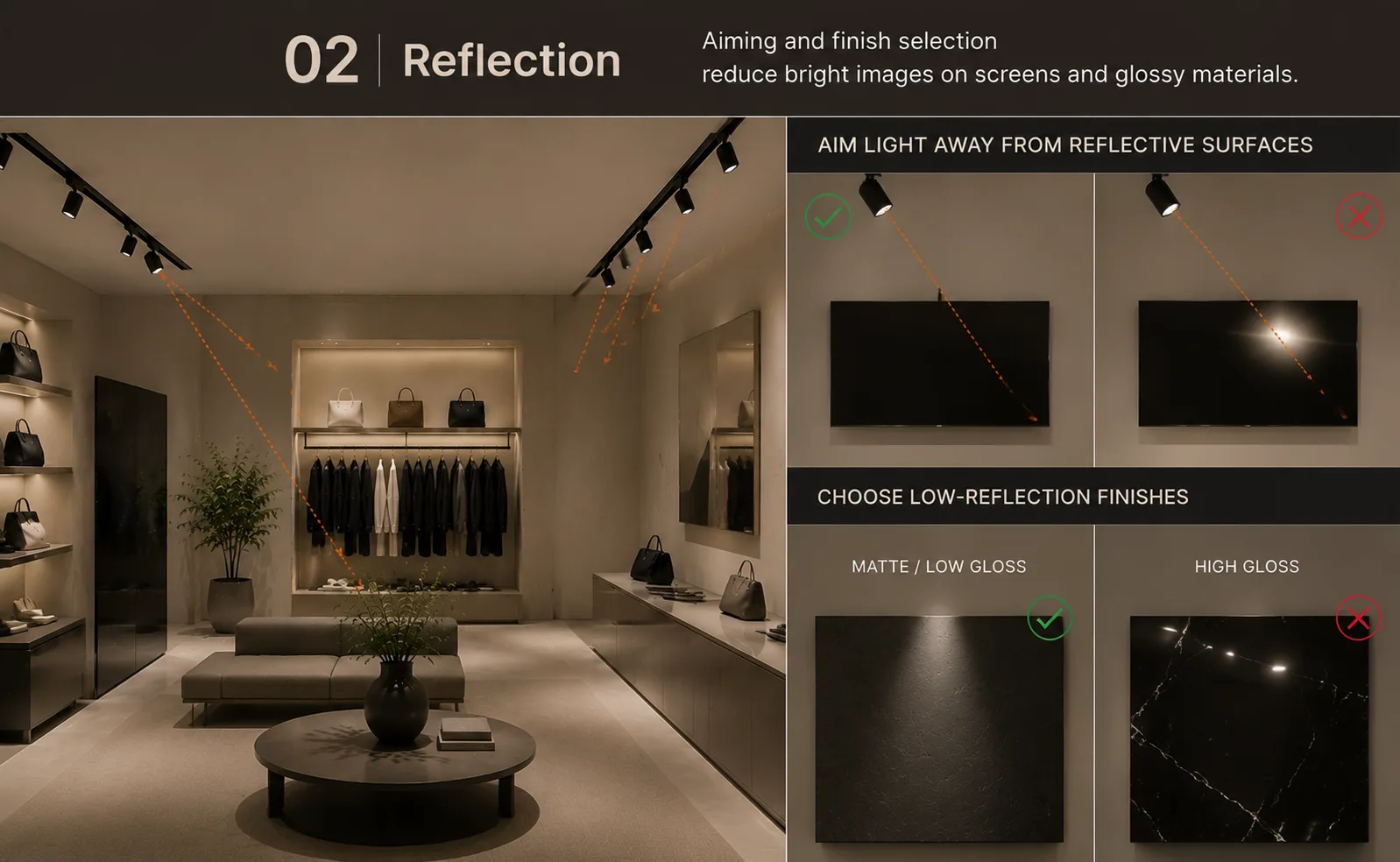
02 Reflection
Aiming and finish selection reduce bright images on screens and glossy materials.
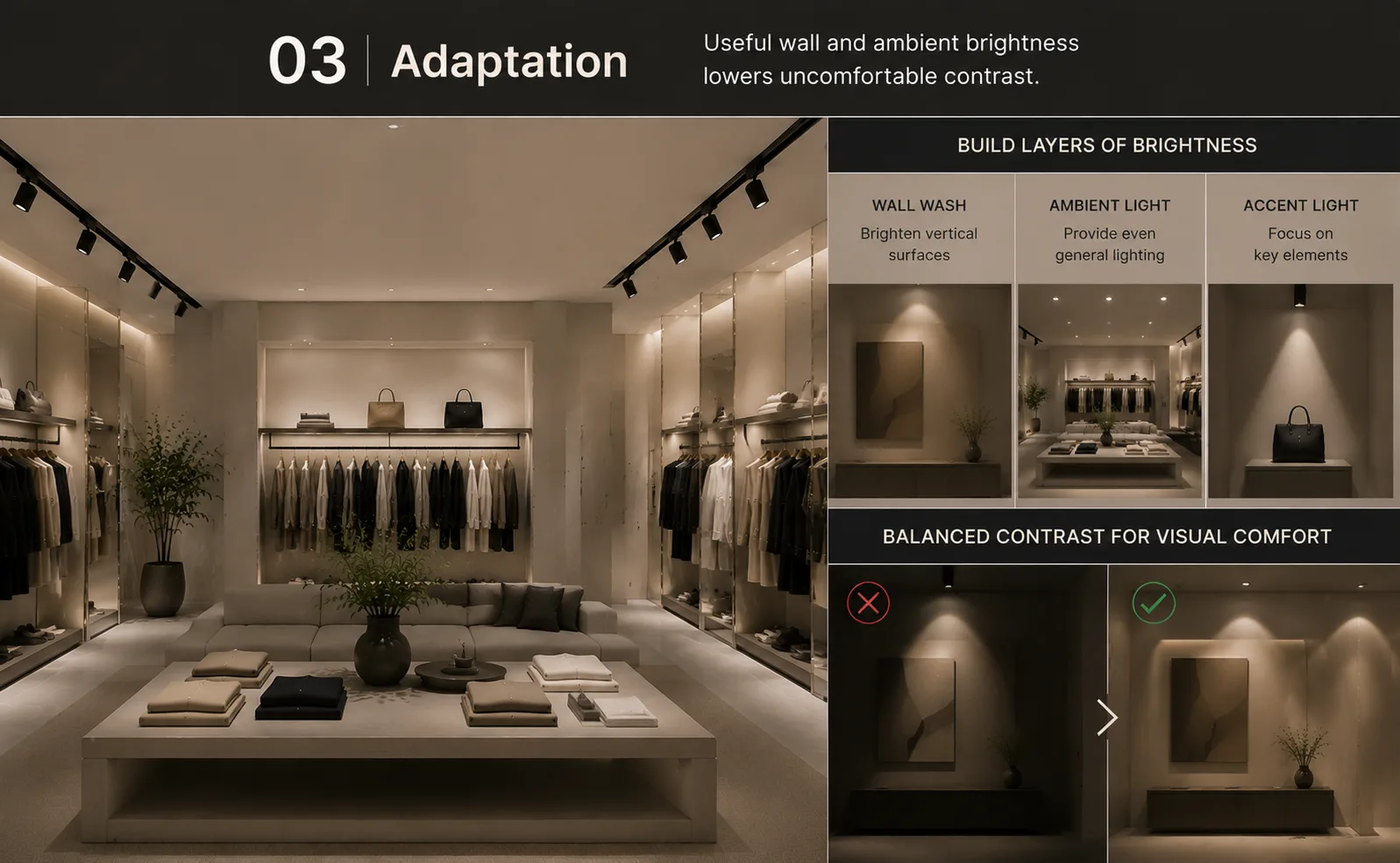
03 Adaptation
Useful wall and ambient brightness lowers uncomfortable contrast.
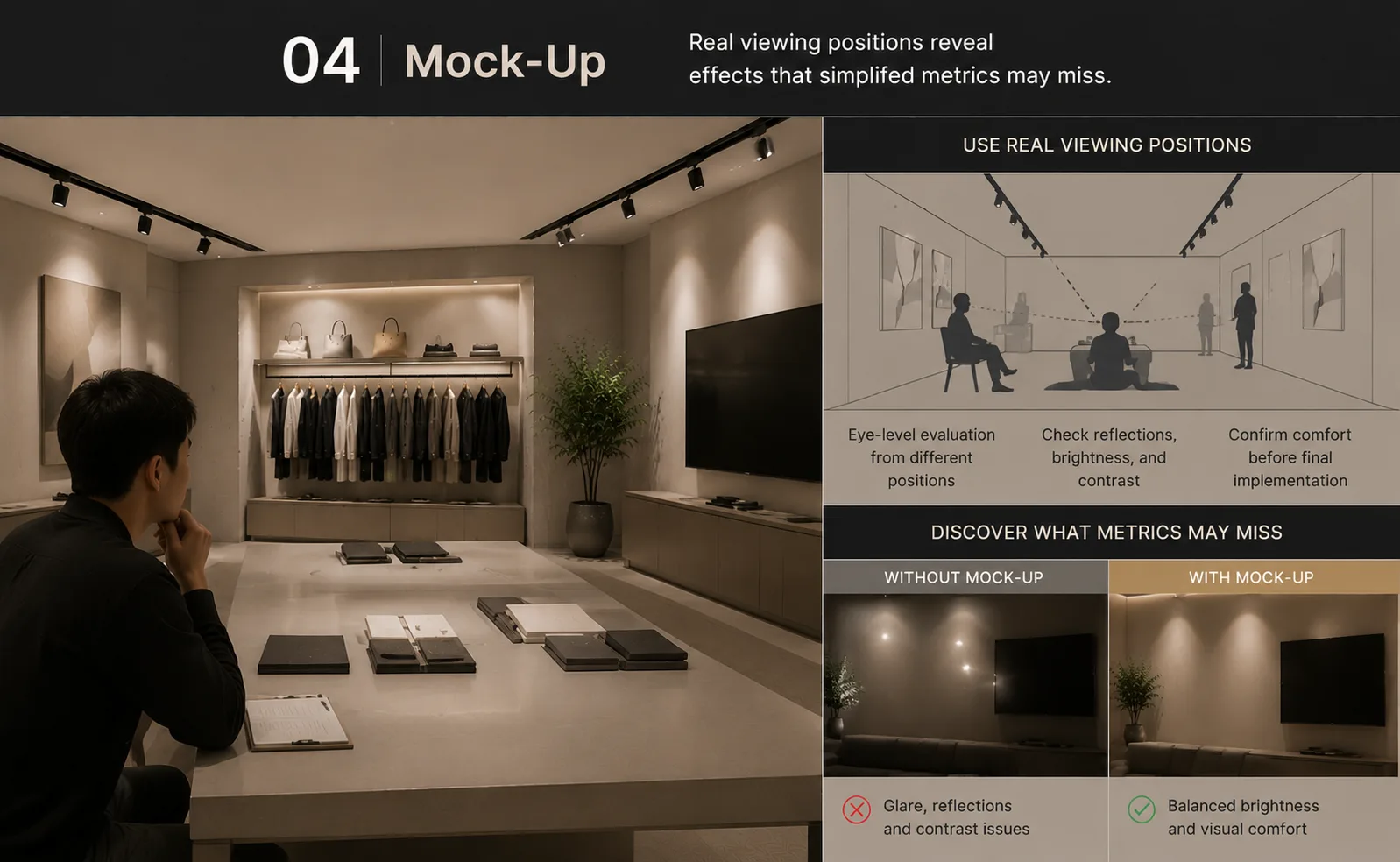
04 Mock-Up
Real viewing positions reveal effects that simplified metrics may miss.
02Recognise the Different Glare Mechanisms
Discomfort glare produces annoyance or fatigue without necessarily preventing vision. Disability glare reduces visual performance through scattered light in the eye. Reflected glare appears when a bright source is mirrored by screens, polished stone, metal, glass or glossy merchandise. Veiling reflections can lower contrast on reading material and displays. Each mechanism calls for a different response. UGR is commonly used for discomfort glare from indoor luminaires under defined conditions, while screen and surface reflections require geometric review. Exterior spill, daylight and very small high-luminance LED points may need additional assessment. A good brief names the problematic viewing conditions instead of asking generically for an ‘anti-glare fixture’.
Glare-Control Responses
| Observed problem | Likely mechanism | Design response |
|---|---|---|
| Bright ceiling aperture | Direct discomfort glare | Increase cut-off and review position |
| Source visible in screen | Reflected glare | Change geometry or shielding |
| Accents feel harsh | Poor adaptation | Restore controlled ambient/vertical light |
03Control the Aperture and the Beam
Deep-recessed light engines, cut-off angles, dark baffles, specular or faceted reflectors, honeycombs and snoots can shield the source or manage stray light. The correct device depends on the distribution and task. SOFT supports fixed low-glare downlighting with a restrained ceiling presence. LITE PRO is relevant where ultra-low-glare modular downlighting is a priority. INTERO adds adjustable high-output capability for directed tasks while retaining attention to visual comfort. These product directions should be matched to actual photometry and luminance data. A honeycomb may reduce high-angle brightness but also change output and beam edge. Adding accessories without recalculating the scene can create dark ceilings or drive unnecessary wattage.
04Design the Room for Better Adaptation
Glare is aggravated by contrast. Brightening vertical surfaces can improve adaptation and make a space feel more generous without simply increasing task-plane lux. Wallwashing, indirect light or softly illuminated architectural elements can support this background. Position fittings away from common approach lines and seated sightlines; in retail, consider customers looking upward toward high shelves as well as staff working at counters. Aim spotlights so reflected highlights do not follow the normal viewing path. Dimming scenes should preserve the relationship between accents and ambient light rather than turning off the supporting layer entirely. Matte finishes reduce mirror-like reflections, but material choice should be coordinated with the lighting rather than treated as a substitute for optical control.
05Verify Comfort Before Repetition
Glare mistakes become expensive when a prototype store or standard room is repeated across a rollout. Calculate UGR where appropriate, inspect luminaire intensity and source luminance at critical angles, and build a representative mock-up. Observe it from standing, seated and moving positions, with displays and screens in place. A retail project may use SOFT for calm ambient zones, LITE PRO for disciplined general lighting and INTERO where adjustable emphasis is needed. The scheme should be judged as a luminance composition, not a collection of ‘anti-glare’ labels. When the equipment recedes and surfaces carry the hierarchy, visitors can examine products comfortably while the architecture retains depth and contrast. Post-occupancy review is especially useful because glare depends on where people actually sit, walk and look. Furniture, displays and digital screens often move after the lighting calculation is complete. Invite users to identify recurring discomfort at different times of day, then verify whether the cause is a visible source, a reflection or inadequate adaptation. The remedy may be re-aiming, an accessory, a revised scene or a change to the surrounding brightness; replacing the luminaire should not be the automatic first response. Record successful corrections so that they survive maintenance and future fit-outs. For repeated project types, feed these observations back into mounting zones and standard details. Anti-glare design becomes more reliable when operational evidence refines the next specification rather than remaining an isolated complaint.