
KEY TAKEAWAYS
- Lumens measure total luminous flux from a source.
- Lux measures illuminance on a surface.
- One lux equals one lumen per square metre.
- Optics and distance change lux without changing source lumens.
- Good design also considers luminance, glare and uniformity.
01A 3,000-Lumen Fixture Does Not Promise 500 Lux
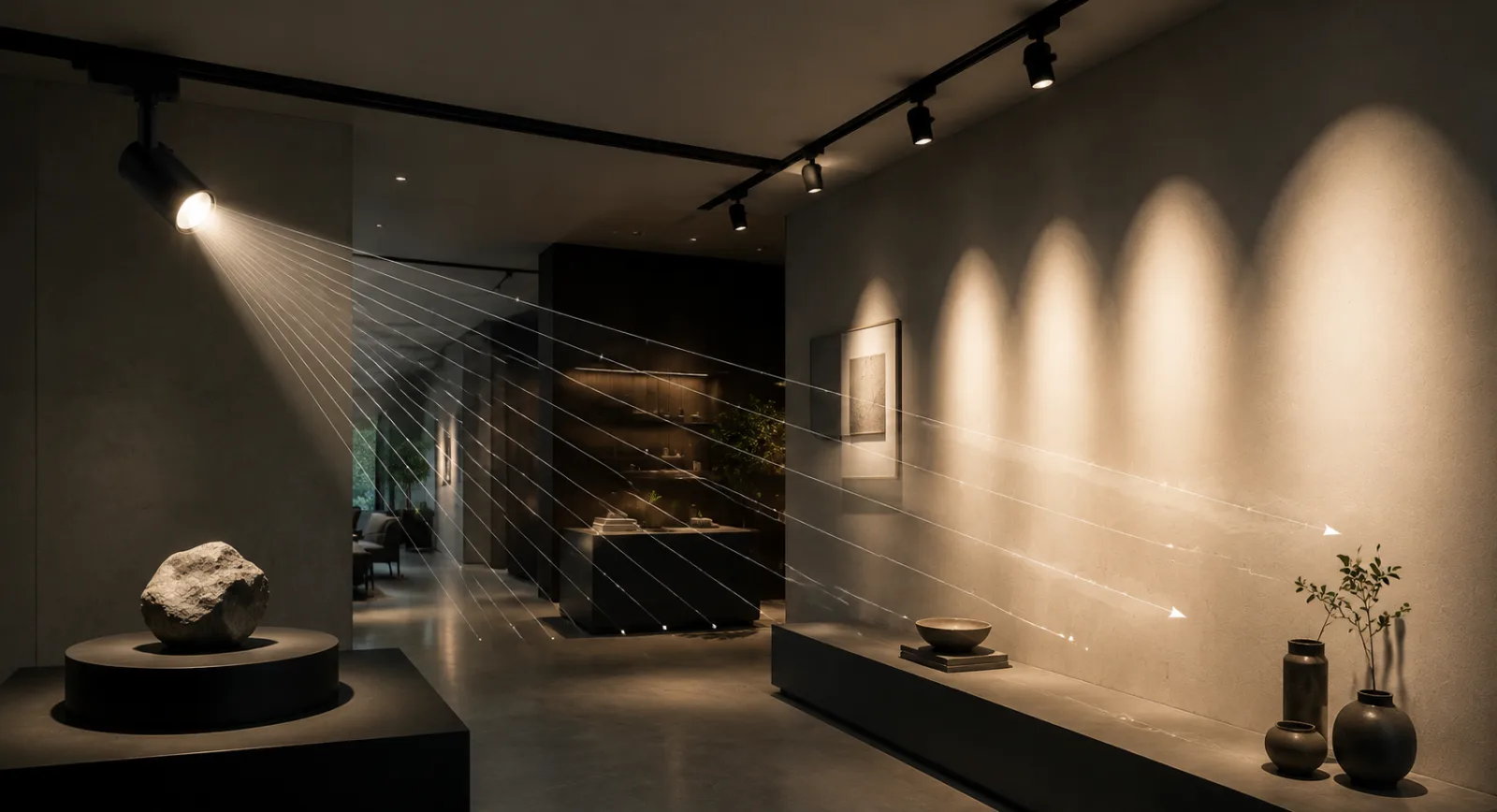
A schedule may show a luminaire delivering 3,000 lumens, while the brief asks for 500 lux on desks. The figures describe different parts of the lighting system. Lumen is the unit of luminous flux: the total quantity of visible light emitted, weighted to human visual sensitivity. Lux is the unit of illuminance: the luminous flux arriving on a surface per unit area. One lux equals one lumen per square metre. The conversion is therefore not a simple product label. It depends on optical distribution, mounting height, spacing, aiming, room geometry, surface reflectance and light loss. A high-output luminaire can create modest task illuminance if its light is distributed widely or mounted far away.
Lux vs Lumen: What's the Difference — Design Essentials
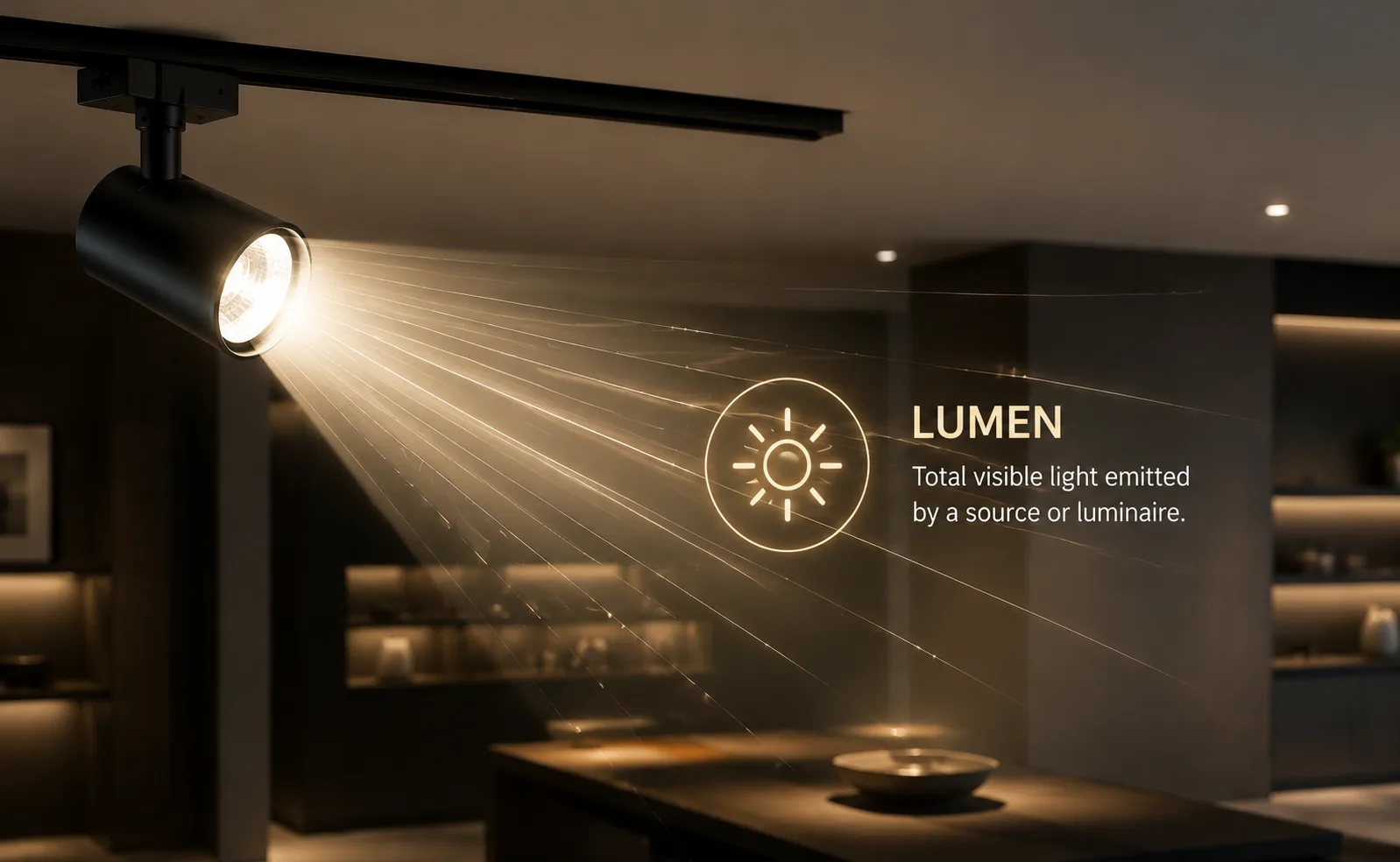
01 Lumen
Total visible light emitted by a source or luminaire.
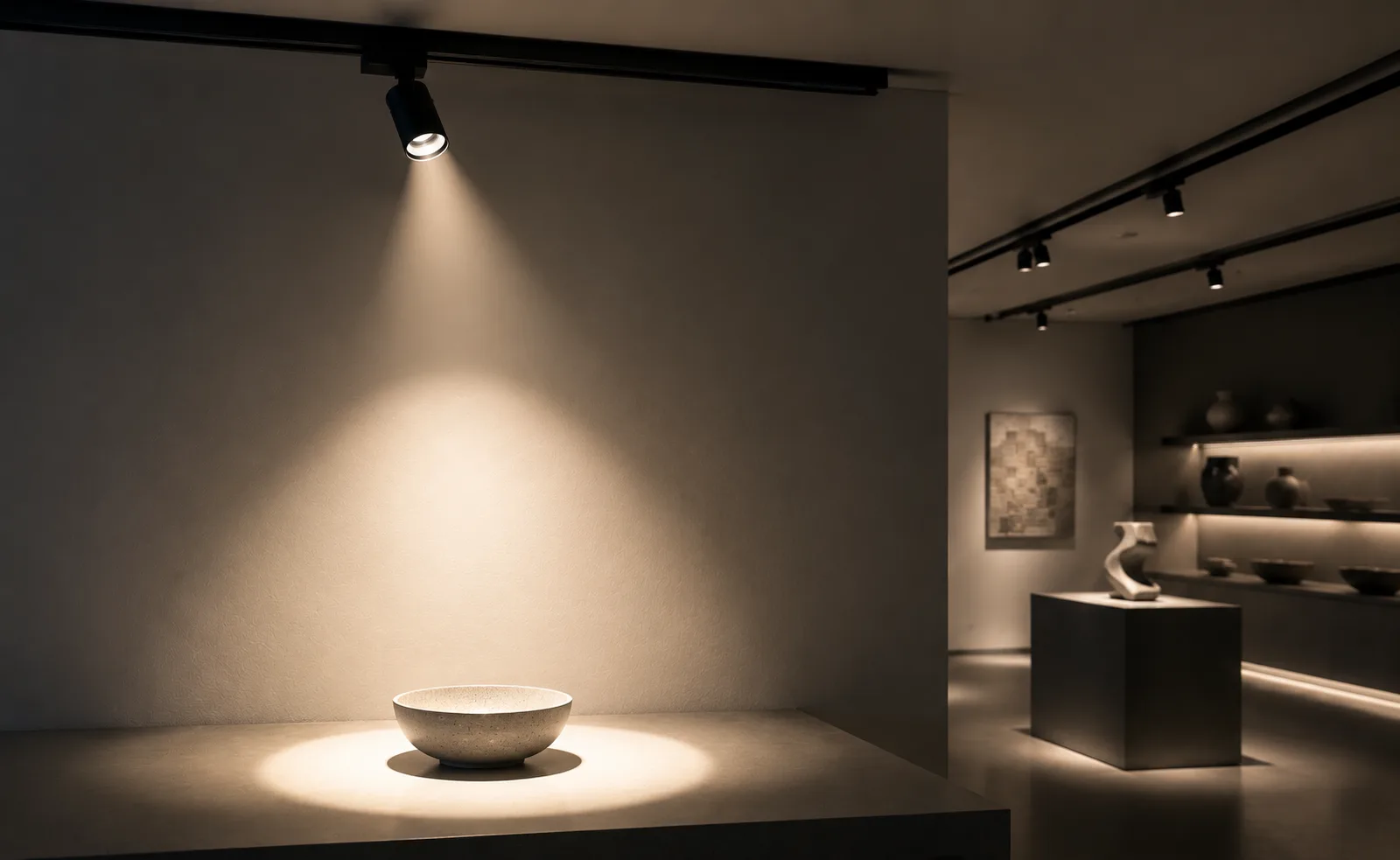
02 Lux
Light arriving on one square metre of a surface.
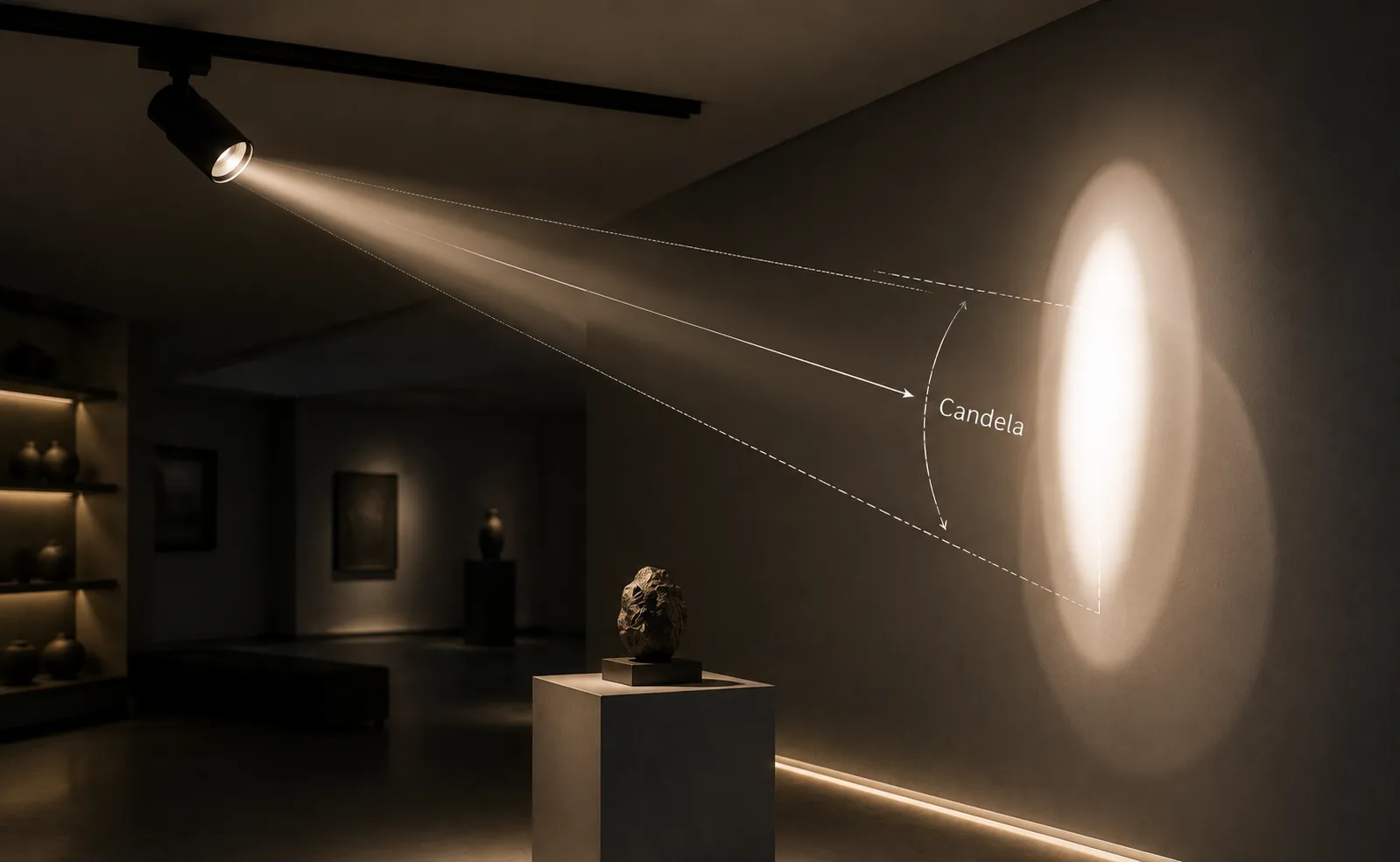
03 Candela
Intensity in a particular direction, useful for focused beams.

04 Luminance
Light leaving a surface toward the observer; central to appearance.
02Distance and Optics Decide Where Flux Goes
For a point-like source aimed perpendicular to a plane, illuminance falls approximately with the square of distance. Doubling the distance can reduce centre illuminance to about one quarter, although real luminaires and reflected light make complete room behaviour more complex. Beam angle redistributes the same general flux: a narrow optic concentrates more intensity into a smaller area, while a wide optic spreads it across a larger footprint. This is why candela, which describes luminous intensity in a direction, is often more useful than lumens for predicting a spotlight’s centre lux. Photometric files combine these relationships and allow calculation software to estimate direct and interreflected illuminance across a grid.
Core Lighting Quantities
| Quantity | Unit | Design question |
|---|---|---|
| Luminous flux | lumen (lm) | How much visible light is emitted? |
| Illuminance | lux (lx) | How much light reaches the surface? |
| Luminous intensity | candela (cd) | How strongly is light sent in one direction? |
03Use Lux Targets Carefully
Illuminance recommendations relate to tasks and should be applied with the relevant standard, measurement plane and assumptions. Horizontal lux on a desk does not describe vertical light on faces, shelving or walls. Average illuminance can also conceal poor uniformity: a few bright points may lift the average while large areas remain dim. Maintained illuminance accounts for output depreciation, dirt and maintenance over time, whereas initial illuminance describes a new installation. Designers should record whether a value is average, minimum or point-specific, and whether it applies to a working plane, floor, wall or object. Daylight contribution and control scenes may require separate calculations rather than one static number.
04Select Output for the Actual Volume
HICORE is suited to high ceilings where substantial output and controlled distribution must bridge a long throw. SLIM addresses tighter ceiling conditions while providing a compact high-output downlight option. Neither should be chosen by lumen output alone. A warehouse-height office atrium, open-plan workplace and low meeting room may need different optics and wattages even if their nominal illuminance targets overlap. Check ceiling constraints, glare, spacing, cut-off, maintenance access and control zones. Excess lumens often create higher power demand and discomfort that dimming must later suppress; insufficient intensity can leave vertical surfaces dull even when the total installed flux appears generous.
05Complete the Picture with Luminance
Lux measures incident light, but people see luminance: the light leaving or reflected from surfaces toward the eye. A matte white wall and a dark timber wall can receive the same lux yet appear very different. Reflectance, gloss and viewing direction shape the result, as do visible luminous apertures. In a commercial office project, a balanced design may combine adequate task illuminance with brighter vertical surfaces, controlled luminaire luminance and useful daylight. The practical sequence is clear: establish the visual tasks, calculate maintained lux on relevant planes, inspect luminance and glare, then verify the atmosphere. Lumens size the available resource; optics and architecture decide whether that resource becomes useful light. Measurement at handover should mirror the calculation assumptions. Use a calibrated meter, define the grid and working-plane height, exclude or document daylight, and allow the installation to stabilise. Record control scenes and supply conditions so the readings can be repeated. If results differ, investigate aiming, output settings, reflectances and installed product codes before adding more luminaires. A point-by-point table can reveal distribution problems hidden by a single average. At the same time, photographing the space or taking luminance measurements helps explain why an area that technically achieves its lux target may still appear flat or glaring. The objective is not to make the measured number agree at any cost, but to confirm that the delivered luminous environment supports work, orientation and comfort with the intended energy use.